Isometric Flag of Japan: A 3D Vector Exploration from Static Precision to Dynamic Motion
In the vast landscape of digital design and vector graphics, few subjects capture the intersection of cultural heritage and modern technology quite like the isometric flag of Japan. While a standard two-dimensional representation of the Japanese flag is instantly recognizable, elevating this iconic symbol into a three-dimensional space opens up new avenues for creativity, education, and branding. This article explores the nuances of rendering the Japanese flag in an isometric static position versus depicting it in motion on a flagpole, providing a comprehensive guide for designers, educators, and enthusiasts alike.
Understanding Isometric Projection in Modern Design
To fully appreciate the visual impact of an isometric flag, one must first understand the underlying geometric principle. Isometric projection is a method for visually representing three-dimensional objects in two dimensions. Unlike perspective drawing, where lines converge at a vanishing point, isometric drawings maintain parallel lines, creating a sense of depth without distortion. This technique has become a staple in modern UI/UX design, infographics, and technical illustrations because it offers clarity and precision.
When applied to national symbols, such as the flag of Japan, isometric projection transforms a flat piece of fabric into a tangible, sculptural object. It allows viewers to perceive the thickness of the material, the curvature of the folds, and the spatial relationship between the flag and its environment. This shift from 2D to 3D is not merely aesthetic; it serves a functional purpose in conveying scale and realism in digital media.
The Symbolism of the Rising Sun
Before diving into the technical aspects of rendering, it is essential to acknowledge the profound significance of the subject. The flag of Japan, known as the Nisshōki or "flag of the sun," features a crimson-red circle centered on a white rectangular field. The red disc represents the sun goddess Amaterasu, and the name Hinomaru translates literally to "circle of the sun."
Historically, this symbol dates back centuries, but its adoption as the official national flag occurred during the Meiji Restoration in the late 19th century. Today, it stands as a powerful emblem of peace, purity, and energy. In the context of 3D vector art, maintaining the integrity of these colors and proportions is crucial. The vibrant crimson (often specified as PMS 186 C) and the stark white must be rendered with accuracy to respect the cultural weight of the image.
Static Precision: The Isometric Flag in Rest
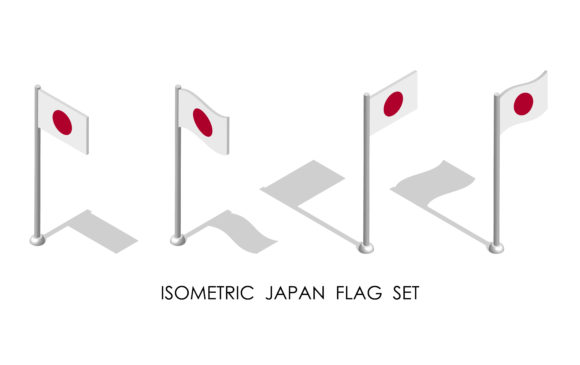
One of the most common requests in 3D modeling is for a flag in a static position. This involves creating a version of the flag that appears frozen in time, often folded neatly or displayed on a rigid structure. In an isometric view, a static flag allows the designer to focus on geometry and form rather than fluid dynamics.
- Geometric Clarity: A static isometric flag is ideal for architectural diagrams or logo variations where the flag needs to fit into a specific grid system. The lack of motion ensures that the circular disc remains perfectly proportioned relative to the rectangle's width.
- Material Representation: Without the distraction of wind, the viewer can appreciate the texture of the vector material. Isometric renders allow for subtle shading gradients that suggest the weight of the fabric, making the flag look like a solid, high-quality object rather than a flat graphic.
- Business Applications: Companies using the flag for international trade shows or educational materials often prefer static versions. They provide a clean, professional look that communicates stability and reliability.
Creating a 3d vector of a static isometric flag requires careful attention to the angle. Typically, the isometric plane is set at 30 degrees from the horizontal. This angle provides the most balanced view, allowing the front face, top surface, and side profile to be visible simultaneously. For the Japanese flag, this means the red circle might appear slightly elliptical depending on the exact viewing angle, a detail that skilled designers adjust to maintain optical correctness.
Capturing Movement: The Flag in Motion
While static representations offer stability, there is an undeniable allure to capturing the flag in motion on a flagpole. Depicting the flag waving in the wind introduces complex challenges and rewards for the artist. It brings the symbol to life, evoking feelings of freedom, patriotism, and natural beauty.
- The Physics of Fabric: Rendering a flag in motion requires simulating how light interacts with moving surfaces. As the fabric ripples, shadows shift rapidly across the red disc and white background. In an isometric view, these dynamic shadows create a mesmerizing dance of light and dark that a static image cannot achieve.
- The Flagpole Structure: To make the motion believable, the pole itself must be robust. An isometric view often reveals the base of the pole and the mechanism holding the flag. Whether it is a simple vertical rod or a more elaborate ceremonial staff, the pole anchors the motion, giving the viewer a reference point against which the waving fabric moves.
- Animation vs. Static Render: In modern web design, "motion" can be achieved through CSS animations or GIFs based on a 3D vector model. However, even a single frame of a waving flag in isometric projection tells a story of movement. The curves of the waves are captured mid-flutter, suggesting velocity and direction.
For developers and content creators, a 3d vector of a flag in motion is invaluable for landing pages, event promotions, and cultural exhibitions. It adds a layer of dynamism that captures user attention immediately. When used in educational contexts, such as history lessons about the Meiji era or geography modules, a waving flag helps students visualize the flag flying over real-world landscapes.
Bridging Tradition and Technology
The transition from traditional 2D graphics to 3D isometric models represents a broader trend in how we interact with information. In the past, flags were represented by flat pixels. Today, they exist as interactive assets that can be rotated, zoomed, and animated. This evolution enhances our understanding of the object itself.
Consider the practical relevance in business. A global company launching a product in Japan might use an isometric flag in their marketing collateral. A static version conveys trust and adherence to local standards, while a dynamic version suggests innovation and forward-thinking. By choosing the right representation, businesses can subtly communicate their brand values.
Common Misunderstandings and Best Practices
Despite the growing popularity of 3D flag designs, several misconceptions persist among amateur designers and users.
Misconception 1: Aspect Ratio Distortion
A frequent error in isometric rendering is altering the aspect ratio of the flag to fit the 3D perspective incorrectly. The Japanese flag has a specific ratio of 2:3 (height to width). Even when viewed from an angle, the fundamental proportions should remain consistent to avoid misrepresentation. In a 3D vector, scaling the flag too much along the Z-axis can make the circle look distorted.
Misconception 2: Ignoring Lighting Direction
In a static isometric view, lighting is crucial. If the light source is inconsistent with the implied environment, the flag may look flat or unnatural. For a flag in motion, the lighting must change dynamically with the folds of the fabric. A well-lit isometric flag will have highlights on the crests of the waves and deep shadows in the troughs.
Best Practice: Semantic Accuracy
Always ensure that the red color is accurate and that the circle is perfectly centered. In 3D software, this might require using precise mathematical constraints rather than freehand tools. For motion, ensure the animation loop is seamless so that the flag does not appear to snap back to a neutral position abruptly.
Conclusion: The Future of National Symbols in Digital Space
The exploration of the isometric flag of Japan in both static and motion states highlights the versatility of 3D vector graphics. Whether used for educational purposes, commercial branding, or artistic expression, these digital representations serve as a bridge between historical tradition and modern technological capabilities.
A static isometric flag offers clarity, precision, and a sense of permanence, making it perfect for technical documentation and formal presentations. Conversely, a flag in motion on a flagpole injects energy and emotion into the design, capturing the spirit of the nation in a way that resonates with audiences on a deeper level. As technology continues to advance, the ways we render and interact with these symbols will only become more sophisticated.
For anyone looking to incorporate the 3d vector of the Japanese flag into their projects, understanding the balance between geometric accuracy and artistic flair is key. By respecting the symbolism of the Hinomaru and leveraging the power of isometric projection, designers can create visuals that are not only visually stunning but also culturally respectful and technically sound. Whether you are building a website, designing a presentation, or creating an infographic, the isometric flag of Japan stands as a testament to the enduring power of visual communication in the digital age.