Christmas Santa Silhouette: A Practical Guide to Selection, Usage, and File Formats
In the realm of seasonal design, few elements are as instantly recognizable or versatile as the Christmas Santa silhouette. While many designers reach for colorful illustrations or complex vector scenes, there is a distinct advantage to choosing the stark, high-contrast look of a silhouette. This approach strips away unnecessary detail to focus on the iconic shape of the figure, creating an image that works across diverse mediums without losing its festive identity.
For professionals aged 20 to 50 who evaluate resources based on utility and adaptability, understanding the specific benefits of this format is crucial. Whether you are preparing large-scale print materials, web graphics, or intricate cut files, the choice of file type and style can determine the success of your project. This analysis explores why the Christmas Santa silhouette remains a top choice for creative projects, how it compares to alternative styles, and what technical specifications matter most for your workflow.
Distinguishing Features of the Silhouette Style
The primary distinction of a Christmas Santa silhouette lies in its reductionist aesthetic. Unlike full-color renderings that rely on gradients, textures, and lighting effects, a silhouette relies entirely on form and negative space. This makes it particularly effective when the goal is to create a graphic that needs to stand out against any background color or texture.
When evaluating different artistic approaches, the silhouette offers a unique set of strengths:
- Universal Legibility: Because the design is reduced to a single solid color (typically black), it maintains clarity even at very small sizes or from a distance. This is a critical factor for signage, merchandise labels, and mobile app icons.
- Timeless Appeal: Detailed cartoonish versions of Santa can date quickly based on current trends. A classic silhouette, however, transcends fleeting design fads, ensuring your project looks professional for years.
- Focus on Composition: By removing internal details like facial features or clothing patterns, the silhouette forces the viewer to focus on the pose and the overall arrangement of the elements within your layout.
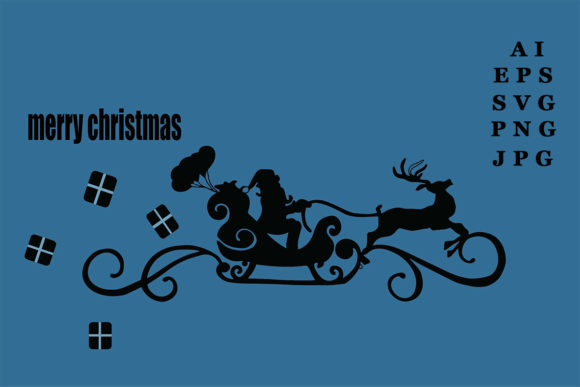
This minimalist approach does not mean the image lacks character. A well-crafted Christmas Santa silhouette captures the essence of the holiday through the curve of the hat, the sway of the coat, and the distinctive beard. It conveys warmth and tradition without the visual noise of a busy illustration.
Navigating File Formats: AI, EPS, SVG, PNG, and JPG
One of the most significant advantages of modern digital assets is the availability of multiple file formats tailored to specific use cases. When selecting a resource, the decision often comes down to the intended output medium. The versatility of a standard package—offering AI, EPS, SVG, PNG, and JPG files—ensures that the same image can be adapted for both screen and print applications seamlessly.
Vector Files: AI, EPS, and SVG
For projects requiring scalability, vector formats are the industry standard. These files define shapes using mathematical equations rather than pixels, meaning the image can be resized infinitely without losing quality.
- Adobe Illustrator (AI) & Encapsulated PostScript (EPS): These are essential for professional printing and further editing. If you plan to modify the design, change colors, or integrate the silhouette into a larger logo suite, these editable source files are indispensable. They support layers and allow for precise manipulation of individual elements.
- Scalable Vector Graphics (SVG): For web developers and UI/UX designers, SVG is the optimal choice. It loads quickly, scales perfectly on high-resolution displays (Retina screens), and can be animated via CSS or JavaScript. An SVG version of a Christmas Santa silhouette ensures crisp edges on every device, from smartphones to large desktop monitors.
Raster Files: PNG and JPG
While vectors offer infinite scaling, raster images provide immediate compatibility with software that does not handle vectors well, such as basic photo editors or certain presentation tools.
- PNG (Portable Network Graphics): The defining feature of a high-quality PNG is the transparent background. This allows the silhouette to be placed over photos, colored backgrounds, or textured paper without a visible white box surrounding the figure. For a resolution of 300 DPI, PNGs are ideal for sublimation printing, t-shirt transfers, and digital overlays where transparency is required.
- JPG (Joint Photographic Experts Group): Although JPGs do not support transparency, they are universally compatible and smaller in file size. High-resolution JPGs are suitable for email newsletters, social media posts, and situations where a white background is acceptable or desired.
Comparing Silhouettes Against Alternative Approaches
When planning a project, designers often weigh the silhouette against other common options, such as detailed illustrations, hand-drawn sketches, or photographic cutouts. Each category serves a different purpose, and understanding the tradeoffs helps in making an informed decision.
Silhouette vs. Detailed Illustration
A detailed illustration might include snowflakes, gifts, reindeer, and complex shading. While visually rich, these elements can clutter a design if the layout is already busy. In contrast, a Christmas Santa silhouette acts as a clean anchor. It provides a focal point without competing with typography or other graphical elements. If your project requires a lot of text or complex data visualization, the silhouette is often the superior choice because it directs attention rather than distracting from it.
Silhouette vs. Photographic Cutouts
Photographic cutouts offer realism but come with limitations regarding consistency and integration. Matching the lighting of a real photograph with the rest of your design can be challenging. A silhouette eliminates this issue entirely; since it is flat and uniform, it integrates effortlessly into any environment. Furthermore, silhouettes are easier to manipulate in terms of color. You can turn a black Santa silhouette red, gold, or green with a single click in your design software, whereas recoloring a photograph requires complex masking and blending techniques.
Silhouette vs. Hand-Drawn Sketches
Hand-drawn styles convey a rustic, artisanal feel. However, they can sometimes lack the precision needed for mass production or digital applications. A professionally created vector silhouette ensures that every line is smooth and consistent. For commercial products like mugs, banners, or packaging, consistency is key. The Christmas Santa silhouette guarantees that the final output looks identical whether printed on one item or ten thousand.
Evaluating Tradeoffs and Best-Fit Scenarios
No single asset fits every scenario. While the Christmas Santa silhouette is highly adaptable, it is important to recognize when it might not be the right tool for the job.
When to Choose the Silhouette
The silhouette is the best choice when:
- High Contrast is Needed: If you need an image that pops against dark backgrounds or low-light environments, the solid black shape provides maximum impact.
- Versatility is Key: If you are unsure of the final background color or layout, a silhouette with a transparent background (PNG) gives you the freedom to experiment without reworking the image.
- Printing Requirements are Strict: For cutting machines (like Cricut or Silhouette) or screen printing, a simple vector path is often more efficient than a complex illustration with hundreds of tiny details.
- Clean Typography is Required: If you want the text to be the star of the show, a silhouette serves as a subtle, elegant frame.
When to Consider Alternatives
There are situations where a silhouette may fall short:
- Emotional Storytelling: If the goal is to evoke a specific narrative or show emotion (e.g., Santa looking sad or excited), a detailed illustration with facial expressions will communicate better than a featureless shape.
- Realism is Essential: For projects aiming for photorealism, such as magazine spreads or realistic advertisements, a silhouette will appear too abstract.
- Color Variety is the Focus: If the project relies heavily on a specific color palette or gradient effects, a solid black silhouette might limit the visual expression unless carefully recolored.
Practical Application and Decision Factors
To make the most of a Christmas Santa silhouette, consider the entire lifecycle of your project. Start by identifying the end-use. Is it for a website? Prioritize the SVG file for performance and sharpness. Is it for a large banner? The AI or EPS file ensures the image won't pixelate when scaled up to massive dimensions. Is it for a t-shirt transfer? The 300 DPI PNG with a transparent background is the standard requirement.
Furthermore, the editability of the source files (AI/EPS) is a major factor for long-term projects. If you anticipate needing to tweak the design next year or adapt it for a different brand, having access to the layered vector files saves significant time and effort compared to trying to recreate or trace a raster image.
Ultimately, the value of a Christmas Santa silhouette lies in its ability to bridge the gap between traditional holiday imagery and modern design efficiency. It offers a balance of familiarity and flexibility that few other styles can match. By understanding the strengths of the silhouette and the capabilities of the various file formats available, designers can select the right resource to enhance their projects without compromising on quality or creativity.
Whether you are a seasoned graphic designer or a hobbyist creating holiday cards, the decision to use a silhouette should be driven by the specific needs of the audience and the medium. When executed correctly, the result is a timeless piece of art that honors the spirit of the season while meeting the rigorous demands of contemporary design.