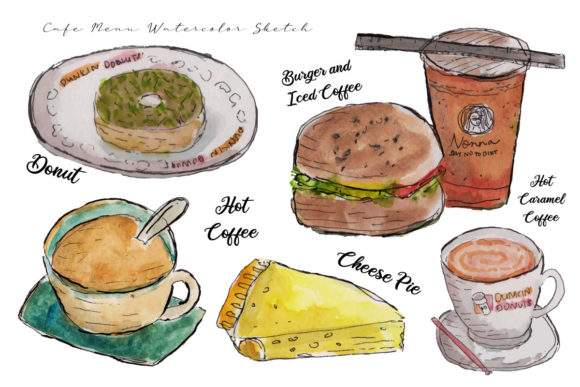
Cafe Menu Food and Drink Watercolor
In the competitive landscape of hospitality and creative design, visual identity often determines the difference between a fleeting customer interaction and a memorable brand experience. The Cafe Menu Food and Drink Watercolor asset represents more than a simple graphic; it is a versatile design element that bridges the gap between artistic expression and commercial utility. For professionals ranging from small business owners to freelance designers, finding high-quality, adaptable assets is critical for maintaining a consistent aesthetic without compromising on production timelines or budget constraints.
This specific watercolor collection is designed with a dual purpose: to serve as a direct decorative element for menus and to act as a foundational layer for broader branding projects. By offering both vector (EPS) and raster (JPG) formats at 300dpi resolution, the design addresses the technical requirements of modern print production while retaining the organic, hand-painted charm that digital illustrations often struggle to replicate. The following analysis explores the practical applications, technical specifications, and strategic value of this asset for various user profiles.
Understanding the Core Design Characteristics
The essence of the Cafe Menu Food and Drink Watercolor lies in its ability to evoke warmth and authenticity. Unlike rigid clip art or generic stock photography, watercolor textures introduce an element of imperfection and human touch that resonates deeply with consumers seeking artisanal experiences. The design typically features soft gradients, bleeding ink effects, and natural color palettes that suggest freshness and quality—attributes essential for food and beverage marketing.
From a technical standpoint, the inclusion of EPS files is a significant advantage for professional workflows. Vector formats allow designers to scale the artwork infinitely without losing clarity, which is indispensable when creating large-scale signage or resizing elements for different menu dimensions. Conversely, the JPG pixel format ensures immediate usability for web-based applications, social media graphics, and quick-turnaround printing jobs where file size management is crucial. The 300dpi resolution specified for the raster files guarantees that the final output will meet the industry standard for high-quality print materials, eliminating the risk of pixelation or blurriness.
Practical Applications in Branding and Marketing
The versatility of this design extends far beyond the traditional coffee shop menu. While its primary function is clearly rooted in cafe decoration, the semantic flexibility of the imagery allows it to be repurposed across a wide spectrum of marketing collateral. Professionals can leverage these assets to create cohesive brand identities that feel unified yet distinct.
- Menu Design: The most direct application involves integrating the watercolor elements into physical or digital menus. These graphics can frame text, separate sections, or highlight signature dishes, guiding the customer's eye through the offerings in a visually pleasing manner.
- Wallpaper and Interior Decor: For entrepreneurs looking to enhance their physical space, these designs can be adapted into custom wallpapers. The high-resolution nature of the files supports large-format printing, allowing businesses to transform walls into immersive brand experiences that reinforce the cafe's atmosphere.
- Invitations and Cards: The artistic style is particularly well-suited for event invitations, such as grand opening announcements, private tasting events, or holiday specials. The organic feel of the watercolor adds a personal touch that formal typography alone cannot achieve.
- Product Posters and Banners: Marketers can utilize these assets to create promotional posters for new product launches. Whether displayed in-store or distributed digitally, the vibrant colors and fluid shapes capture attention effectively in crowded environments.
Evaluating Quality and Usability for Professionals
When evaluating creative assets, professionals prioritize consistency, reliability, and ease of integration. The Cafe Menu Food and Drink Watercolor demonstrates strong performance in these areas. The separation of layers in the EPS format, if available, allows for granular control over individual elements. This means a designer can isolate a specific fruit illustration or a coffee cup motif without affecting the surrounding composition, facilitating complex layout adjustments.
Furthermore, the color consistency inherent in watercolor designs helps maintain brand integrity. In many industries, inconsistent coloring can undermine a brand's perceived professionalism. Because these assets are created as a cohesive set, they ensure that every piece of communication—from the table tent to the website banner—shares a unified visual language. This uniformity builds trust with the audience, signaling that the business pays attention to detail.
However, users should be aware of potential limitations regarding customization. While the vector format offers scalability, the organic nature of watercolor might require careful handling during manipulation. Over-editing or attempting to force geometric precision onto fluid shapes can result in a loss of the intended aesthetic. Therefore, the design is best utilized by those who understand how to work with texture and flow rather than strict grid systems.
Strategic Value for Different Audiences
The utility of this asset varies depending on the specific needs of the user group. For small business owners and entrepreneurs, the primary benefit is cost-efficiency and speed. Instead of commissioning a custom artist or spending weeks sourcing disparate images, they can acquire a complete, high-resolution suite of graphics instantly. This allows them to focus resources on operations and customer service while still presenting a polished image.
Freelancers, bloggers, and publishers find value in the asset's adaptability. A blogger writing about culinary trends can use the watercolor images to break up text and add visual interest to articles. Similarly, freelancers working with cafe clients can quickly prototype menu layouts or promotional materials using these pre-made elements, significantly reducing turnaround time and increasing billable hours.
Marketers and educators may utilize the design for case studies or training materials. The clear distinction between the food and drink elements makes it an excellent tool for demonstrating principles of visual hierarchy, color theory, and layout composition. The high resolution ensures that examples used in workshops or presentations remain sharp and professional.
Implementation Recommendations and Considerations
To maximize the effectiveness of the Cafe Menu Food and Drink Watercolor, it is recommended to pair the artwork with complementary typography. Since the visuals are soft and textured, fonts with clean lines or classic serif styles often provide the best contrast, ensuring readability without competing with the background elements. Avoid overly decorative typefaces that might clash with the organic feel of the watercolor.
For print production, always verify the color profile settings. While the JPG files are high resolution, converting RGB images to CMYK for professional printing may result in slight color shifts. It is advisable to test prints before committing to large batches. Additionally, when using the design for digital banners, consider compressing the files appropriately to ensure fast load times without sacrificing the visual impact.
The long-term value of this asset is anchored in its timeless appeal. Trends in graphic design cycle rapidly, but the classic watercolor aesthetic remains relevant due to its association with craftsmanship and quality. Investing in such a resource provides a foundation that can support a brand for years, adaptable enough to evolve with seasonal changes or menu updates.
Conclusion on Utility and Fit
In summary, the Cafe Menu Food and Drink Watercolor serves as a robust tool for anyone seeking to elevate their visual communications within the food and beverage sector. Its combination of artistic merit and technical precision makes it suitable for a wide array of applications, from intimate card designs to expansive wall murals. By providing both vector and high-resolution raster options, it caters to the diverse workflow requirements of modern creators.
While no single asset can solve every design challenge, this collection offers a reliable starting point that balances creativity with functionality. For professionals who value efficiency, quality, and aesthetic coherence, it represents a practical addition to any design library. Whether you are launching a new cafe, refreshing an existing brand, or simply looking to enhance your creative portfolio, this design offers the flexibility needed to execute professional-grade projects with confidence.